 Howard Hubler
 A sales funnel is a tool you need. It is a sales model that shows the overall state of affairs and any specific indicator, from a manager’s performance to the conversion of leads into repeat purchases.
Today, I will explain how to build a sales funnel and the stages involved in creating one in the world of consumers and sellers. I will show you how to build a sales funnel using email marketing and give you some useful tips.
What is a sales funnel?
A sales funnel is the customer’s journey from learning about a product to purchasing it. In its simplest form, the journey looks like this: first, a person learns about the product, then tries a free version, and then buys a paid version. A sales funnel is created in the form of a clear diagram that outlines each stage of this journey: how the customer should behave, what the company does to achieve this, and what results should be obtained.
Why you need to build a sales funnel
A sales funnel is a “road map,” a comprehensive tool for analysis, control, and forecasting. It schematically displays the company’s interaction with customers and helps to:
- Optimize the customer’s path to purchase. Make the customer experience simple and enjoyable, while saving your employees time and energy.
- Improve the performance of each stage. Know exactly how changes at one stage affect the entire subsequent chain of the funnel.
- Create a “return path” — a path that the customer will follow again and again through the funnel to purchase your products.
- Monitor employee performance. See who closes the most successful deals and who puts off “difficult” customers.
- Build sales forecasts based on average values.
How to create a sales funnel — stages
The sales funnel looks different from the perspective of the buyer and the business. The company must calculate both options: understand how the buyer sees their path to a deal and how to combine this path with internal business processes.
Stages of building a sales funnel in the customer’s world
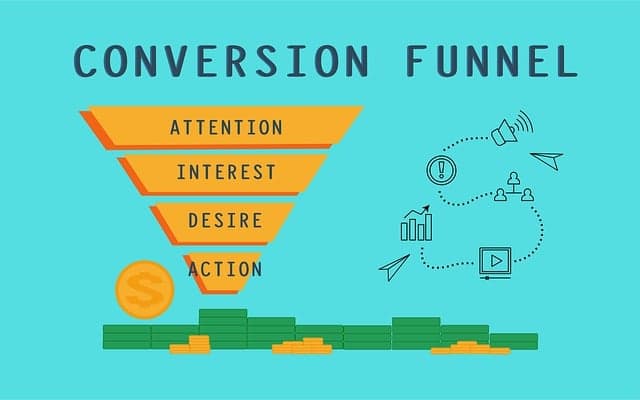
The customer goes through the consumer funnel, which can be broken down into four stages before purchase according to the AIDA model:
- Attention. Learn about the product from advertising, friends, and other sources.
- Interest. Become interested, look for additional information.
- Desire. Want it, make a purchase decision.
- Action. Buy.
AIDA helps you understand how to attract a potential audience. Create profiles of your potential customers and analyze them at each stage: where this person might learn about the product, where they will look for details, what will be attractive to them, where and how they will find it convenient to buy. Use this information when building your sales funnel.
Stages of building a sales funnel in the business world
For business, the sales funnel looks different. In simple terms, the process looks like this: think about who and how best to offer the product, find suitable customers, and persuade them to make a deal.
Stage 1 — Forming an offer
First, you form a USP — a unique selling proposition, or your positioning in the market. A USP (also called an offer) explains why customers should choose you and what benefits and bonuses they will receive. Read our blog to learn how to create a strong selling offer.
When creating a USP, don’t chase uniqueness, but first think about how you can be useful. Buyers will come and stay not for uniqueness, but for a quality product and service that best meets their needs.
Stage 2 — Collecting leads
A lead is a potential buyer who has left at least one contact to continue communicating with the company. For example, they subscribed to an email or SMS newsletter, left a phone number, or wrote to you on social media.
Leads should be divided into primary and secondary leads according to their level of interest. Primary leads are cold, from the first two stages of the sales funnel. They have only just learned about the product, but do not want to buy it yet; they are simply interested. Secondary leads are warm; they are already familiar with the product and want to buy it from you or your competitors. Warm leads can be passed on to the sales department for processing.
Stage 3 — Warming up interest
You have divided your leads into primary and secondary, given the secondary ones to the salespeople, and carefully kept the primary ones for yourself to warm up and prepare for the deal.
If you work with leads online, continue to warm them up where the contact occurred — in email newsletters, social networks, messengers. At this stage, you can offer the lead an additional point of contact: if they receive emails, invite them to join a social media group or subscribe to a Telegram channel, and vice versa. B2B companies usually give a product presentation at this stage.
Stage 4 — Addressing objections and concerns
A warm lead may be warm not only for you, but also for your competitors. They definitely want to buy and are now deciding from whom. It’s time to work delicately with their concerns — dispel all doubts and fears before the final purchase decision.
If you have been generating interest through newsletters, blogs, and social media, continue this stage there. Include publications in your content plan that will address any concerns your customers may have. If your customers work with managers, have them offer all possible options for assistance. At this stage, it is important to refine your customer communication scripts: when you identify a common customer difficulty, add it to the scripts.
Stage 5 — Closing the deal
This is a crucial stage where you need to “push” the buyer to make a purchase. Be sure to consider this stage when creating your sales funnel. For example, online stores often encounter abandoned shopping carts: the customer added the product to the cart but did not pay and left. Maybe they found out that delivery was too expensive, or they simply left to browse competitors’ websites in search of a better deal.
Online stores deal with abandoned carts: if an item has been in the cart for more than an hour, an automatic chain of emails with reminders and bonuses is triggered to encourage the customer to make a purchase.
Customers also disappear when working with a manager — they take a break “to think” and no longer get in touch. At this point, you can’t just wait passively for the customer to make a decision. Clarify any questions they may have and try to move the deal to the next stage — schedule a meeting, send an invoice, and so on.
Stage 6 — Repeat sales, building loyalty
A customer who has made a purchase is like an old friend who is better than two new ones. If they are satisfied, they will buy regularly, and regular customers bring the company the most profit.
Building loyalty takes time: you need to create an emotional attachment to the company in the customer. This attitude ensures that they will not leave for competitors at the first more advantageous offer. This means that you need to maintain a good level of product and service quality, pamper customers with increasing bonuses for loyalty, and personalize communication whenever possible.